Gtrontec FDE Frontline Notes | The master says “based on experience”—how can AI learn?
In multiple industrial AI projects for manufacturing customers, the Gtrontec FDE team goes deep into business sites. Focusing on high-precision needs such as yield monitoring, exception ticket handling, and equipment analysis, it helps customers sort out business rules and connect data and systems, embedding AI capabilities into specific workflows.
FDE, or Field Deployment Engineer, turning engineers’ experience into executable judgment logic is a key task in driving industrial AI implementation. This experience includes not only explicit operating rules but also sample screening, data linkage, exception handling, and risk boundaries. If these conditions are not fully identified, an AI system may still fail to meet business requirements even if it runs according to the requirements document. Therefore, FDEs need to combine technical capabilities with on-site business understanding, clarify engineers’ judgment bases and operating conditions, and then turn AI value into system capabilities through development and validation.
“Gtrontec FDE Frontline Notes” will share, through specific projects, the team’s practices and methods for solving on-site problems and driving industrial AI implementation.

This issue focuses on a yield monitoring project at a panel factory. The AI system issued anomaly alerts based on rules provided by engineers, but in the initial launch phase, excessive alerts affected usage. The team’s retrospective found that the AI system implemented explicit anomaly judgment rules but missed the “denoising” judgments that engineers make in daily operations regarding factors such as sample size and normal fluctuations.
To address this issue, the Gtrontec FDE team gradually completed the implicit judgment conditions through on-site observation, historical record review, and launch feedback, and incorporated them into business specifications and execution processes, laying the foundation for subsequent capability reuse.
1. Complete the applicable conditions in experience
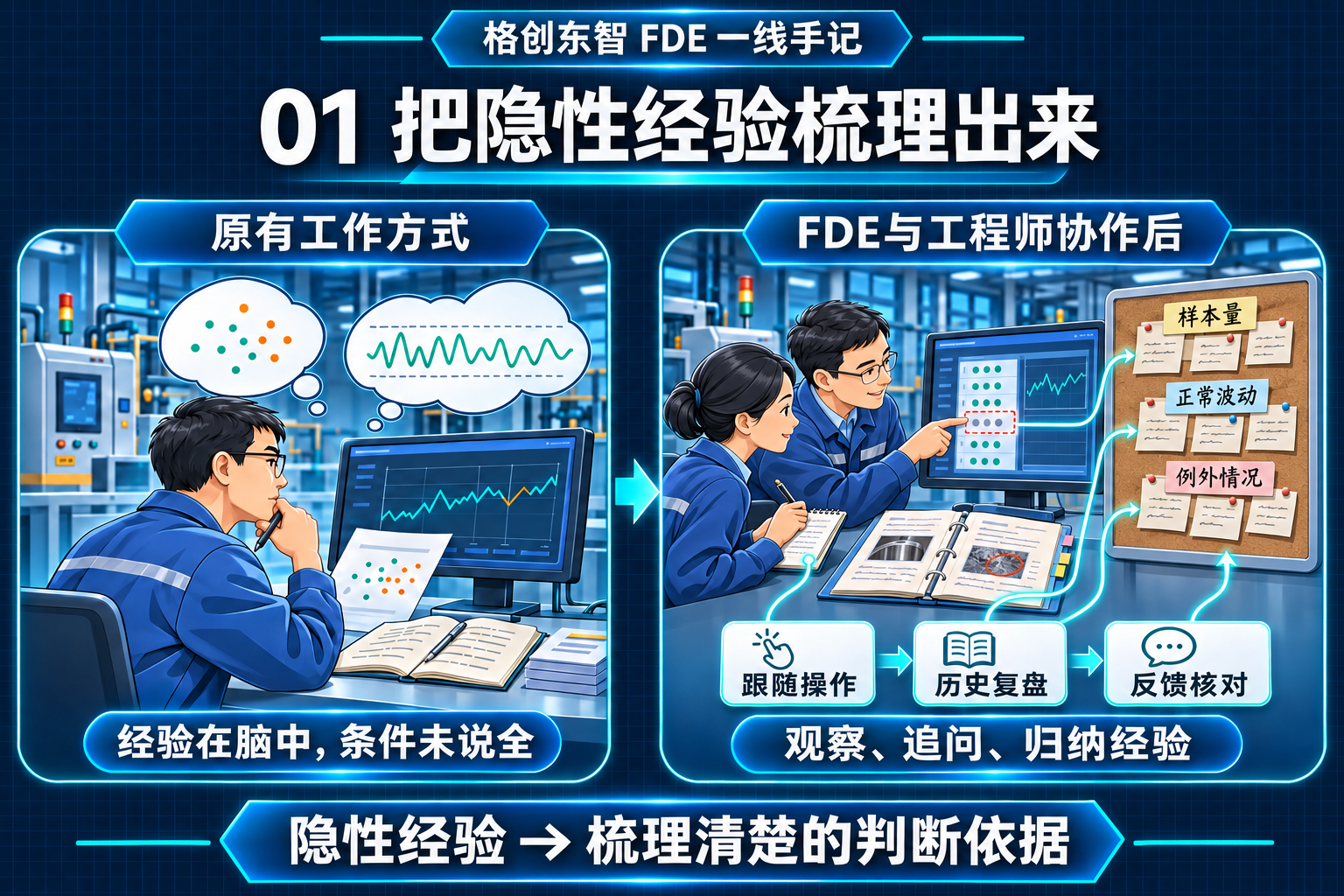
In defect density monitoring, engineers not only check whether the indicator rises continuously or exceeds the threshold, but also judge whether the sample size is sufficient, whether the fluctuation is worth analyzing, and whether it is a normal change in production rhythm.
These screenings usually occur before formal analysis. Engineers are already familiar with their applicable conditions, so when describing requirements, they tend to give the final anomaly judgment rules directly and omit the pre-filtering process.
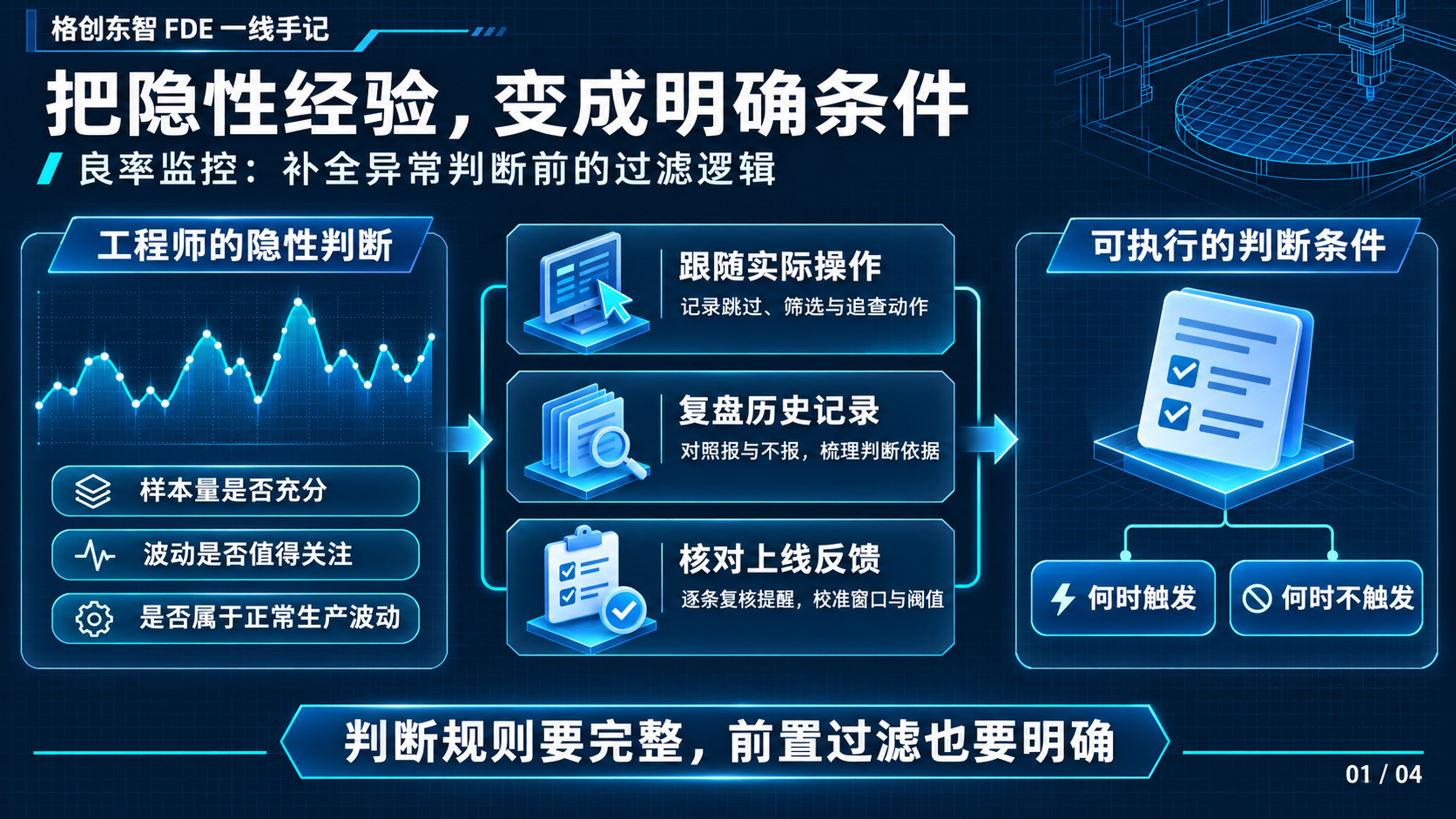
The Gtrontec FDE team uses three methods to complete these conditions:
Follow actual operations. Observe the complete process from opening data to forming a judgment, and record actions such as skipping, filtering, and further investigation. For example, engineers skip product data with too small a sample size, which means the system needs to first determine whether the sample is meaningful for reference before conducting anomaly analysis.
Review historical records. Select historical exception tickets and ask engineers to explain the basis for handling each one, while comparing cases that did not trigger handling, to sort out judgment conditions from different outcomes. In the exception ticket handling scenario, the team used this method to clarify the handling logic corresponding to the relationship between different anomaly counts and additional inspection counts in equipment chamber clustering judgment.
Check launch feedback item by item. Give system-generated alerts to business personnel for review, and turn “too many alerts” into specifics: which should be kept, which should be excluded, and which conditions need to be modified. The team adjusted monitoring windows and thresholds accordingly, then conducted on-site validation.
Together, these three methods address the completeness of experience. It is necessary to clarify both when to take action and when action should not be triggered.2. Write the judgment process into executable specifications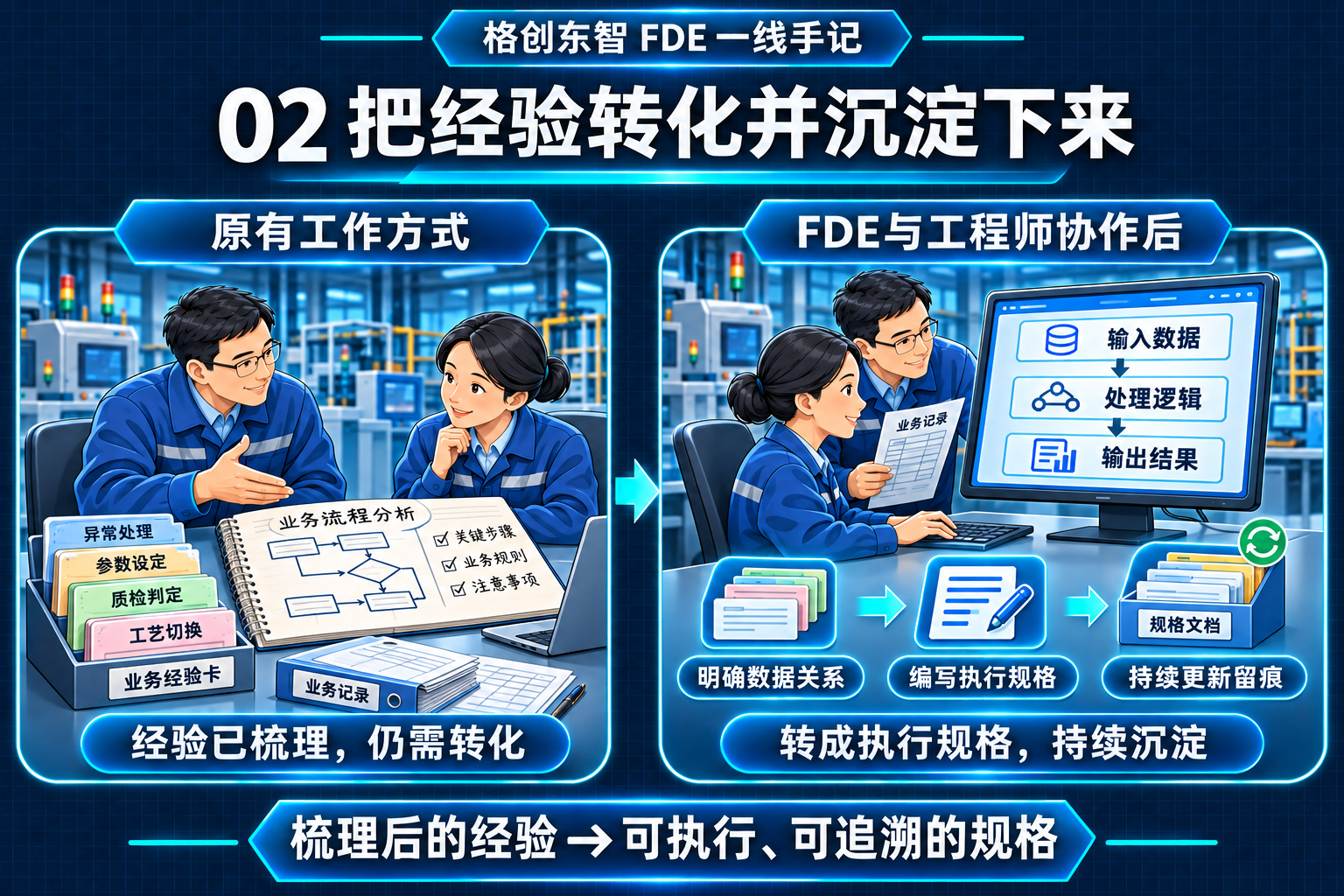
Once experience is identified, it still needs to be translated into specific relationships among data, conditions, and operations. The Gtrontec FDE team adopts a specification-driven development approach, writing business logic into specification documents as a common basis for development and iteration.
Taking equipment clustering analysis as an example, the engineer’s analysis process is broken down into:
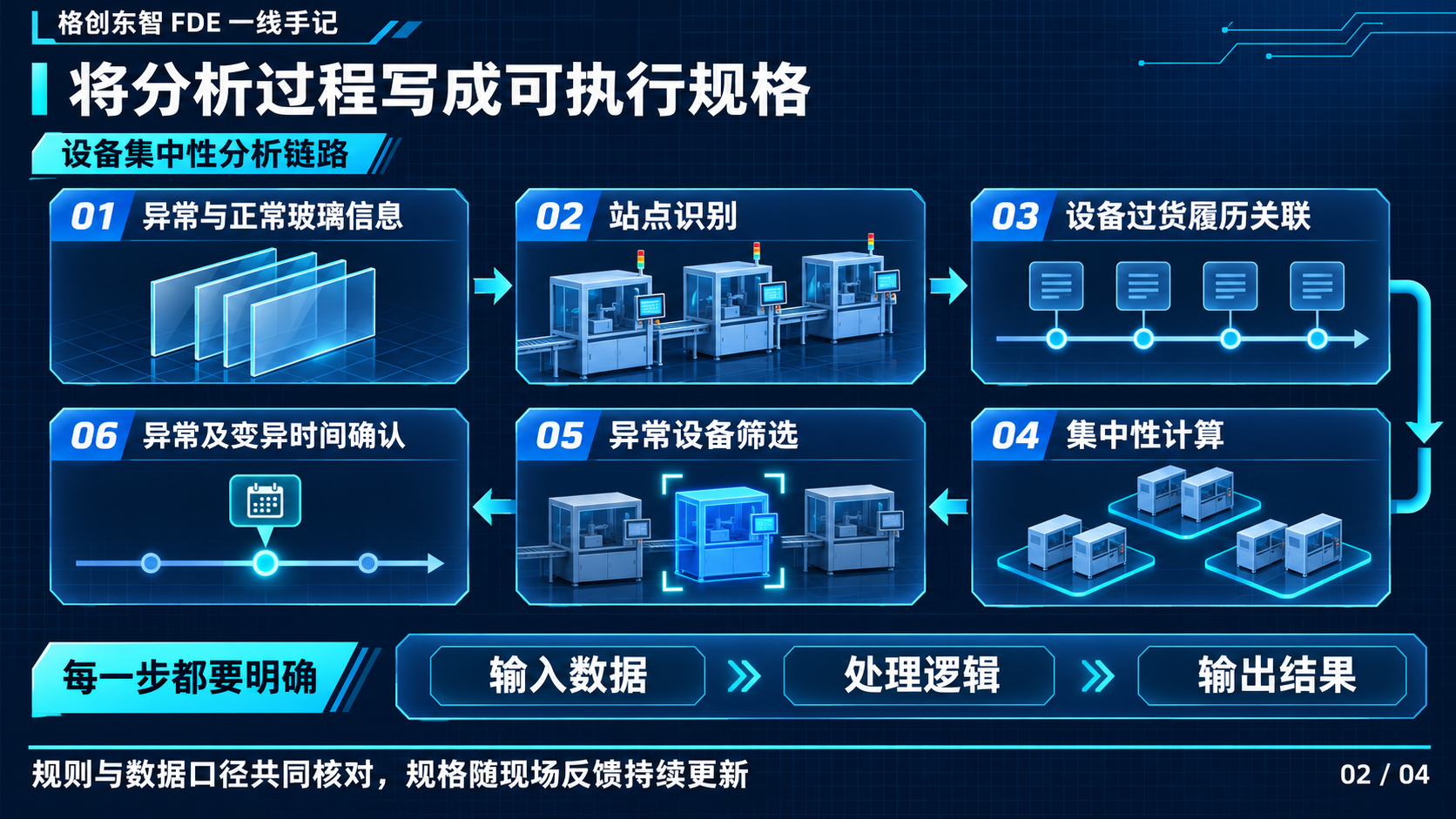
Analysis process breakdown
01 Abnormal and normal glass information → 02 Site identification → 03 Equipment processing history linkage → 04 Clustering calculation → 05 Abnormal equipment screening → 06 Abnormality and variation time confirmationEach step requires clear input data, processing logic, and output results. Merely writing “analyze abnormal equipment” is not enough to guide system execution; where the data comes from, how it is linked, and what conditions are used for screening must all be further defined.
Among these, data definitions directly affect judgment results. For example, defect density calculation requires linking defect data with posting data by time and product; LOSS monitoring also involves numerator and denominator definitions across different factories. Even if interfaces are connected, incorrect linkage relationships or statistical definitions will still cause subsequent judgments to deviate from business reality.
Therefore, Gtrontec FDE’s work covers both business rule sorting and data relationship verification. Specification documents also need to be continuously updated with on-site feedback so that rule changes are traceable.
3. Determine technical solutions and execution permissions by task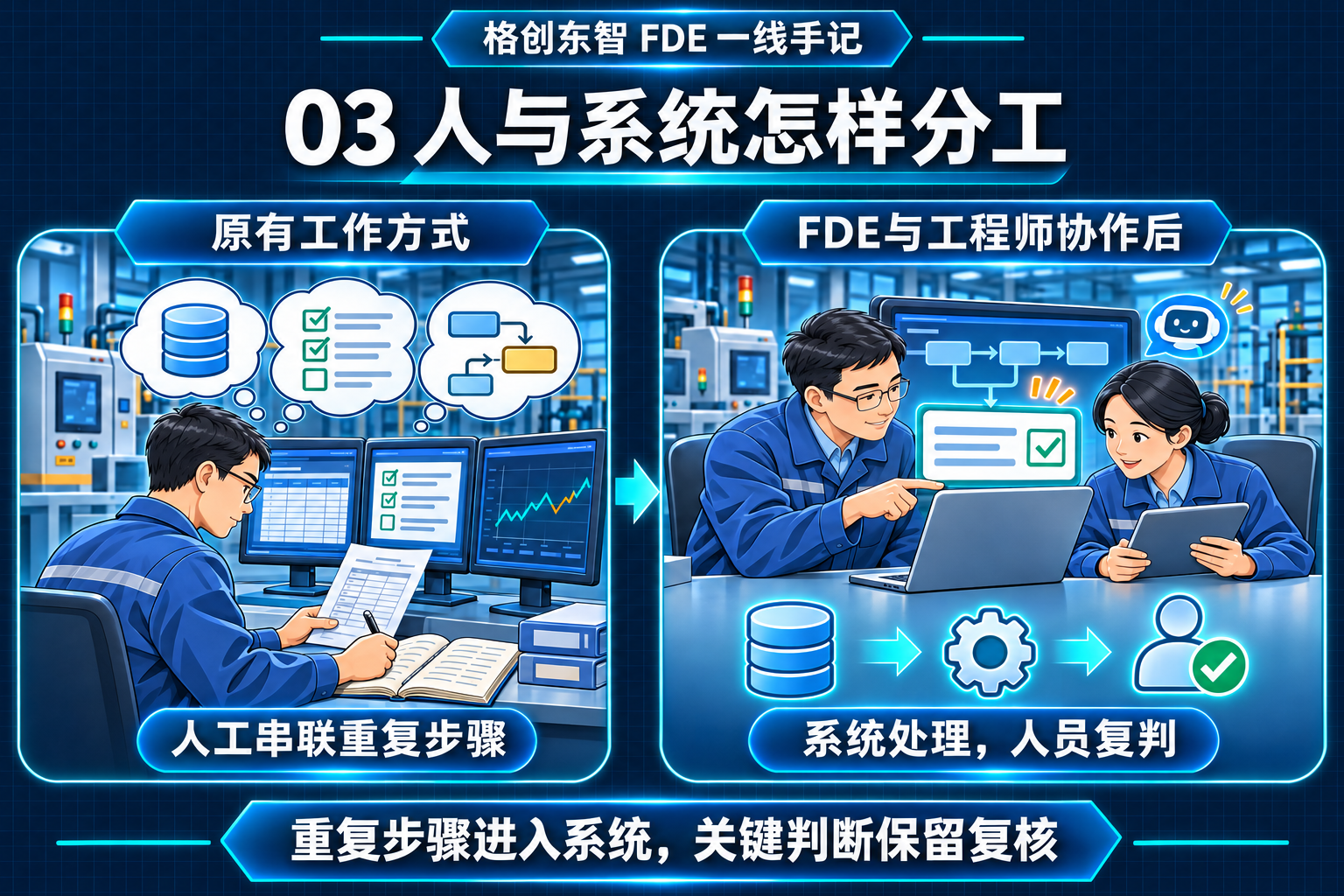
Turning experience into industrial AI capabilities requires further distinguishing which steps are suitable for deterministic execution and which steps require model participation in judgment.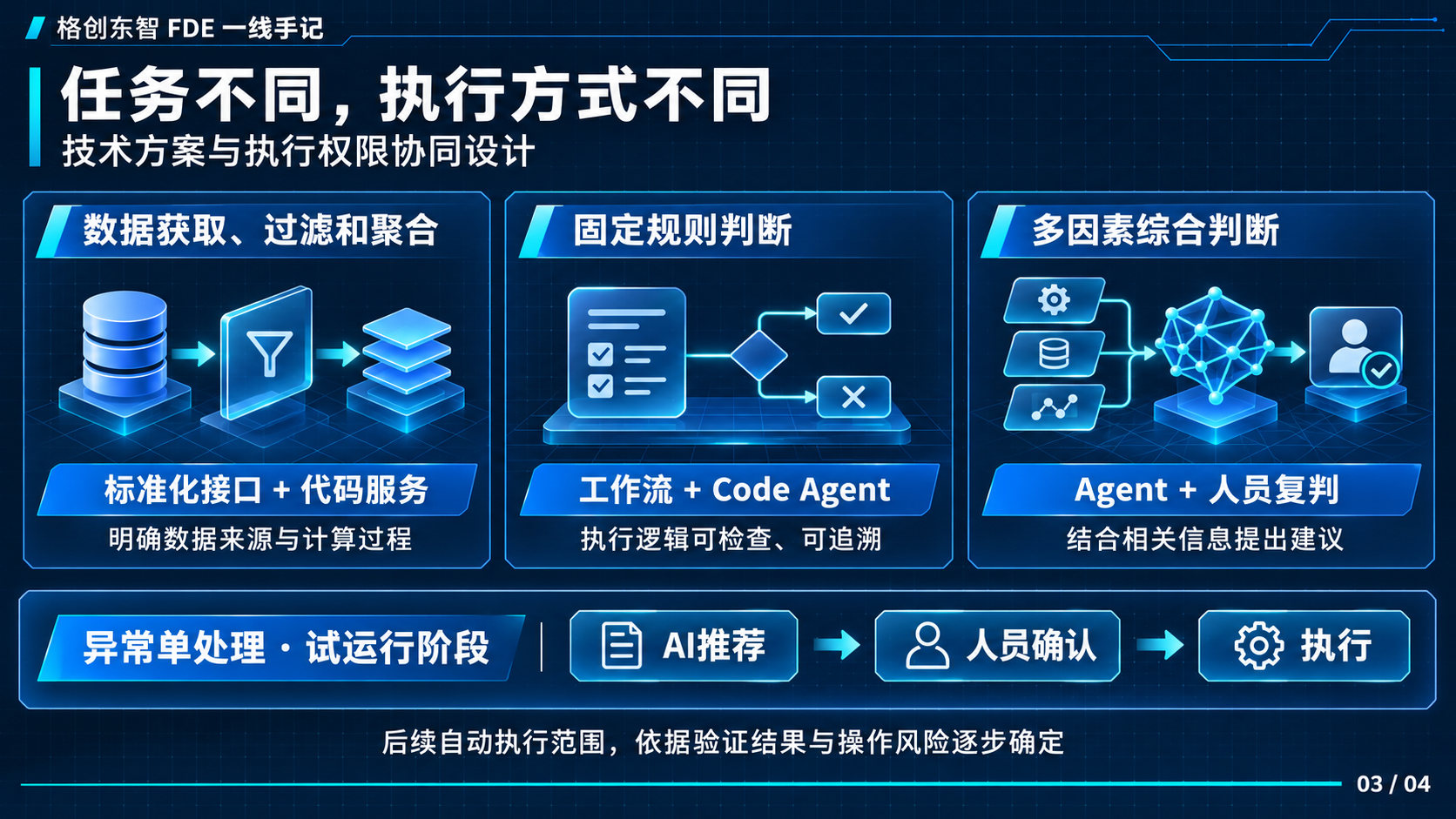
In the projects covered by the interviews, the team adopted the following division of labor:
1.Data acquisition, filtering, and aggregation: handled through standardized interfaces and code services, with clear data sources and calculation processes.
2.Fixed-rule judgment: implemented through workflows, Code Agent, and other methods, making execution logic easy to check and trace.
3.Multi-factor comprehensive judgment: the Agent proposes recommendations based on relevant information, and manual review steps are set according to business risk.
In this process, Code Agent can assist in generating deployable code application services; this does not mean that a large model must answer anew every time a fixed rule is executed.
During the trial run of exception ticket handling, the team treated AI judgment results as recommendations, which were executed after manual confirmation. The subsequent scope of automated execution was gradually determined based on trial-run validation results and specific operational risks.
This makes experience transformation include two requirements at the same time: the AI system can process tasks according to clear logic and can also comply with the execution boundaries set by the business.
4. Consolidate project experience into reusable components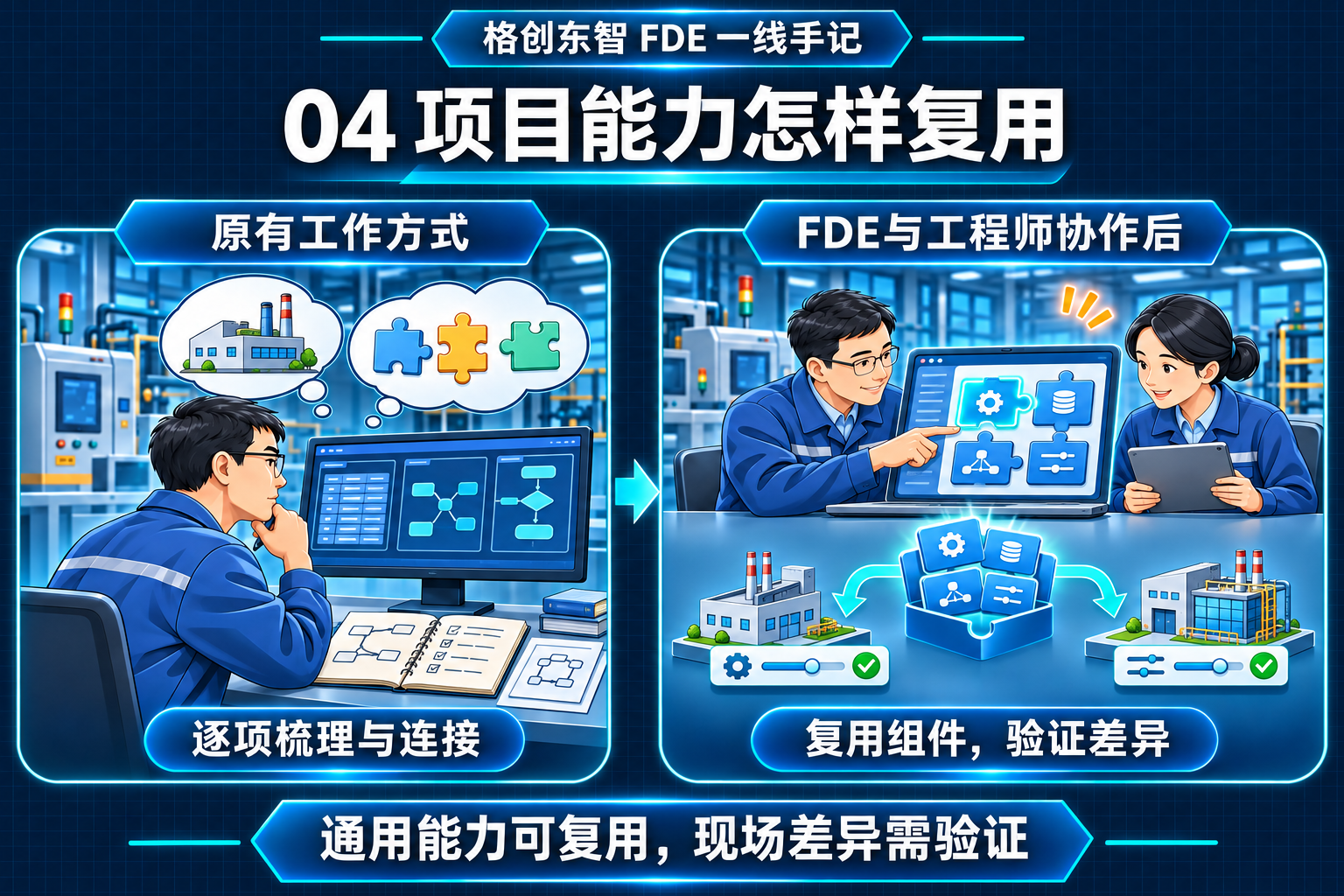
Whether on-site experience can continue to play a role also depends on what is left after the project is completed. In relevant projects, the Gtrontec FDE team encapsulated capabilities such as glass information acquisition and main station information acquisition into platform standard functions and standard plugins for use in subsequent scenarios; it organized validated multi-dimensional monitoring processes into Agent templates for similar needs in other factories.
Reuse across different projects requires distinguishing general capabilities from on-site configuration. Data acquisition processes, interface encapsulation, and analysis steps can serve as a reuse foundation; specific data sources, field mappings, filtering conditions, and judgment thresholds need to be re-verified against the new site.
Through continuous business demonstrations and user feedback, the GTronTec FDE team verifies whether these capabilities meet actual needs, then promotes mature components into the platform capability system.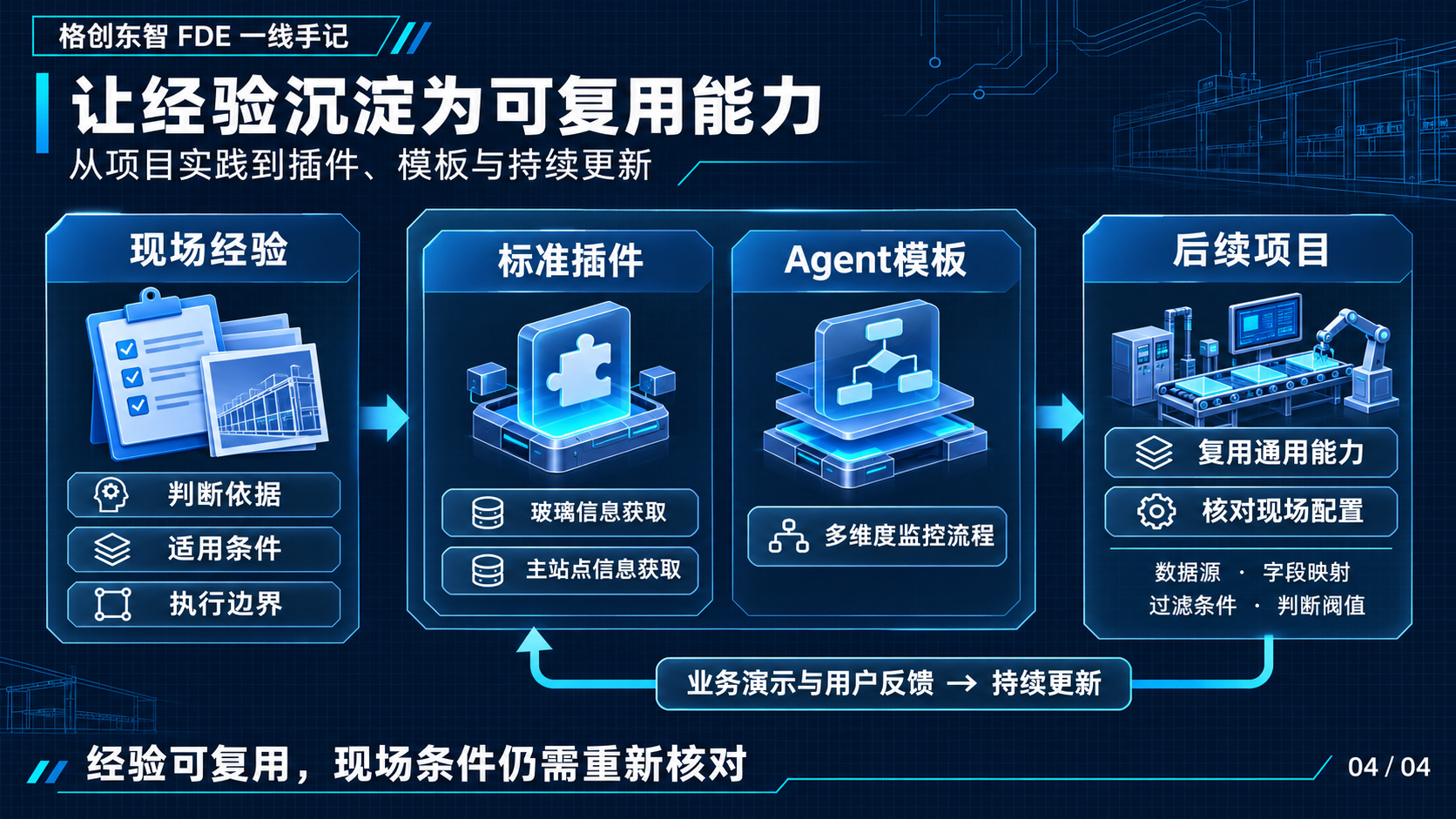
From implicit judgment to executable specifications, from on-site validation to component reuse, FDE turns engineers’ experience into capabilities that the organization can continuously use and update. This is also the practice path of GTronTec Industrial FDE: go deep into business sites, clarify data and judgment logic, complete engineering implementation, and consolidate validated capabilities.
To let experience keep “working,” the premise is to clearly explain the basis, conditions, and boundaries of that experience.
Next issue preview: Why can’t the same solution be used directly in another factory? See how Gtrontec FDE draws the boundary between “reusable” and “requires customization.”